

Panzi Foundation and Hospital Staff Reflect on the World Cup that Reached Across the Frontlines
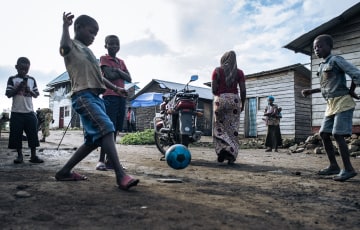
The DRC Leopards’ run at the 2026 World Cup was about far more than football history. It gave the world something rare: a glimpse of a people who, in spite of everything, refuse to be broken, standing together, flag in hand. For weeks, millions of Congolese were swept up in it. On the streets of Kinshasa and in the alleyways of Goma, Bukavu, Bunagana, and Beni, the same eruptions of joy, the same songs, the same electricity. For the first time in 52 years, the Leopards were on the world stage, and the whole country was holding its breath.
At Panzi Foundation and Hospital, where the work makes it hard to to forget what the people in eastern Congo are living through, the tournament hit differently. Caregivers, psychosocial counselors, field staff, everyone felt it. Vira put it simply: seeing the Leopards at this World Cup was “something like a bandage over the wound, the shame that war and the disregard for our humanity have left on us.“
But not everyone could just celebrate.
Some felt joy and grief at the same time. Thérésita didn’t hold back: “Football is a leisure activity, and leisure is something only a free person can really enjoy. Someone who is at peace. Who has enough to eat. Who can meet their basic needs without fear. The whole world has shown up for this World Cup. Why won’t it show up for the thousands of Congolese in the East, in North and South Kivu, who are living under occupation, trapped in their own homes, with no work, no banks, no airports, no freedom? If I were a Congolese player, I don’t think I could play. Because on the same day a family is burying someone, their child could not dare think of scoring goals. The war in eastern Congo, the Ebola epidemic, these should be triggering the same level of global response. The world that comes together for a football tournament could come together twice as powerfully for the people of eastern Congo who are suffering. I have no words for how devastating it is to watch the world stay silent.”
Vermis took that anger and turned it into something that sounds almost like a rallying cry: “In a country that has been torn apart by war, disease, and sealed borders, where the international community still can’t seem to find its footing, a group of Congolese people with a football did something no one thought possible: they got the guns to go quiet, long enough for an entire people to feel joy. That brief ceasefire along the front lines tells us something important: walls come down when people decide they should. If the desire to celebrate together was stronger than the war, then the desire to protect civilians and get humanitarian aid through should be even stronger.
“Peace isn’t some distant miracle. It’s a choice. Silence the guns. Joy is contagious, and it’s truly the most powerful driving force of development we have.” – Vermis
The 2026 World Cup showed the world a different DRC, not the one defined by its crises, but a nation that is resilient, passionate, and deeply united when it matters. At the same time, it raised a question that deserves an honest answer: why does the world find it so easy to mobilize for a sporting event, but not for the people whose lives are being destroyed by war and neglect?
For Panzi Foundation and Hospital, this world cup journey reinforces a profound convition: the dignity of a people is not measured only by its victories, but by its ability to stand tall, to hope, and to demand justice, even in the most harrowing circumstances. And if football can silence the guns – even for a moment – then anything becomes possible. Provided the world agrees to look beyond the playing field.