





WASHINGTON, July 13, 2026 – As the UN Security Council prepares to convene an Arria-Formula meeting on natural resources and peace today, Panzi Foundation is urging member states to move beyond existing approaches focused primarily on risk management and accountability, and embrace a justice-first approach that addresses the structural drivers of resource-related conflict and ensures that natural resource governance delivers lasting peace and shared prosperity.
The gap exposed by the Democratic Republic of the Congo
The Democratic Republic of the Congo’s initiative for this discussion recognizes a central challenge facing the international community: existing approaches to natural resource governance have not prevented the continued use of minerals to fuel conflict, undermine development and deepen insecurity. Panzi Foundation’s contribution is to highlight a critical dimension of this gap: the limited integration and enforceability of justice-centered principles within mineral governance systems, which remain largely oriented toward due diligence, risk management, and traceability rather than proactively ensuring meaningful benefit-sharing, participation, and effective remedy when harm occurs.
For more than two decades, responses to conflict-linked minerals have prioritized disclosure and corporate due diligence, and more recently, traceability. These remain necessary as tools, but the DRC experience shows they are not sufficient to drive outcomes. While some due diligence obligations are increasingly becoming mandatory, the obligations that determine whether mineral governance produces just outcomes remain fragmented and insufficiently enforceable.
As demand for critical minerals and other natural resources accelerates, securing supply cannot be separated from building legitimate and resilient mineral value chains. Supply chains built on unresolved grievances, exclusion and harm are not secure supply chains; they are sources of fragility that can undermine development and create insecurity beyond producing regions. The future of global mineral security therefore depends not only on reliable physical access to resources, but on governance systems that ensure minerals are sourced, transformed, and traded in ways that respect human and community rights and create equitable value from mine to market.
Not an absence of law, but an asymmetry in international governance
International law is not silent on natural resources. Permanent sovereignty over natural resources connects resource sovereignty to national development and the well-being of people1. The Right to Development recognizes the right of people to participate in and enjoy development and calls for the fair distribution of its benefits2. International human rights law, international humanitarian law, and business and human rights standards provide further protections.
The Security Council has recognized the relationship between natural resources and conflict, especially in the DRC, where its reports date from the early 2000s. Its practice has developed its own due diligence guidelines, imposed sanctions, and progressively addressed illicit exploitation, trafficking and the economic lifelines of armed groups. Most recently, resolution 2773 (2025) recognized illegal natural resource exploitation as a root cause of the conflict in eastern DRC and called for greater transparency, traceability, certification, and due diligence. However, there is a clear opportunity to strengthen this architecture by moving beyond preventive measures toward a more transformative governance approach that establishes binding commitments to ensure extraction contributes to shared prosperity, environmental responsibility, and durable peace.
The most operationalized mineral governance rules focus on identifying risk, tracing origin, and regulating market access. The principles most directly concerned with who benefits, who participates, and how harm is repaired remain dispersed or weakly operationalized. The problem is one of fragmentation and asymmetry.
The economic consequences of the gap are significant. In 2024, the DRC accounted for 74 percent of global cobalt mine production3. Yet UNCTAD finds that processing and refining capture a disproportionate share of value: in 2022, refined cobalt averaged $20.8 per kilogram compared with $6.6 per kilogram for raw material4.
Three justice tests for future frameworks
Panzi Foundation proposes that existing and future natural resource governance frameworks be assessed against three questions:
- Distributive justice: Who benefits?
Traceability and risk-focused due diligence do not equal or lead to benefit-sharing. A just mineral governance framework must proactively assess whether the value generated by extraction contributes to the development of mineral-producing countries and mining-affected communities.
Relevant considerations include revenue-sharing, community benefit mechanisms, local procurement, skills development, employment, gender equity, access to finance, and local value addition. These principles are already reflected in permanent sovereignty over natural resources, the Right to Development and the UN Secretary-General’s Panel on Critical Energy Transition Minerals. The challenge is making them measurable and enforceable. The DRC illustrates that the gap is not always the absence of legal provisions, but their implementation. For example, the 2018 Mining Code introduced community development mechanisms and royalty-sharing provisions, yet oversight bodies have identified persistent challenges in revenue transparency and the management of community development funds.
- Procedural justice: Who decides?
A just mineral governance framework must assess whether affected communities have meaningful decision-making power over activities affecting their land, livelihoods, and futures.
Key considerations include access to information, meaningful participation, representation in governance structures, gender-responsive decision-making, and respect for free, prior and informed consent (FPIC). While FPIC is increasingly recognized in international standards, its application across mineral governance frameworks remains fragmented and largely non-binding. The DRC illustrates this challenge: while national mining and environmental frameworks require consultation and community agreements (cahiers des charges), they do not establish a general right to FPIC. Closing this gap requires moving beyond consultation toward mandatory and meaningful participation and consent standards.
For Panzi Foundation, this dimension is inseparable from gender justice: women and survivors cannot remain visible only as victims of harm while being excluded from the decisions, institutions, and governance systems that shape the economic structures connected to that harm.
- Restorative justice: What happens when harm occurs?
Due diligence is primarily reactive. Yet in conflict-affected mineral regions, including eastern DRC, communities continue to bear the consequences of decades of conflict, illicit exploitation and illegal trade, displacement, loss of livelihoods, and conflict-related sexual violence.
Restorative justice requires addressing both implementation gaps and accountability gaps by creating pathways for recognition, repair, and non-repetition. Existing domestic mechanisms, including mining royalties, community development funds, and social obligations, can contribute to repairing the social and economic impacts of extraction, but persistent governance and implementation failures often limit their transformative potential. At the same time, international mineral governance frameworks provide limited avenues to address responsibility, accountability, and meaningful reparative measures for actors who have benefited from conflict-related mineral exploitation. Instead, it focuses on occasional sanctions and periodic statements of concern.
National civil-liability laws in consumer countries offer one potential avenue, but their reliability varies considerably and is not fixed over time. National due diligence laws demonstrate emerging pathways for accountability but remain fragmented and uneven. While some jurisdictions provide avenues for civil liability for human rights harms across supply chains, others rely primarily on administrative enforcement or have yet to establish effective remedies. The DRC’s own experience illustrates these limitations: efforts to seek accountability for alleged conflict-linked minerals in international supply chains have faced significant legal and jurisdictional barriers, highlighting the absence of a coherent mechanism for remedy across complex mineral value chains.
A system capable of tracing minerals across jurisdictions should also be capable of tracing and identifying responsibility when serious harm occurs. Future frameworks should therefore consider not only grievance mechanisms and access to remedy, but also accountability measures, reparations, and pathways for communities affected by historical and ongoing harms.
Implications for the July process: Toward a Justice-Centered Governance Framework
The question is not simply whether a future instrument should be binding or voluntary. The prior question is: binding around what? Panzi Foundation encourages the July process to:
- assess existing natural resource governance frameworks against distributive, procedural, and restorative justice;
- recognize fair5 benefit-sharing and local value addition as core governance principles, grounded in the Right to Development;
- require active, free and meaningful participation of affected communities, including women, survivors, in the design and governance of future frameworks (including dedicated UNSC debates);
- examine a coherent remedy architecture capable of addressing past, current and future harm across mineral value chains; and
- ensure that any future international process ensures direct and inclusive civil society participation.
An illustrative method
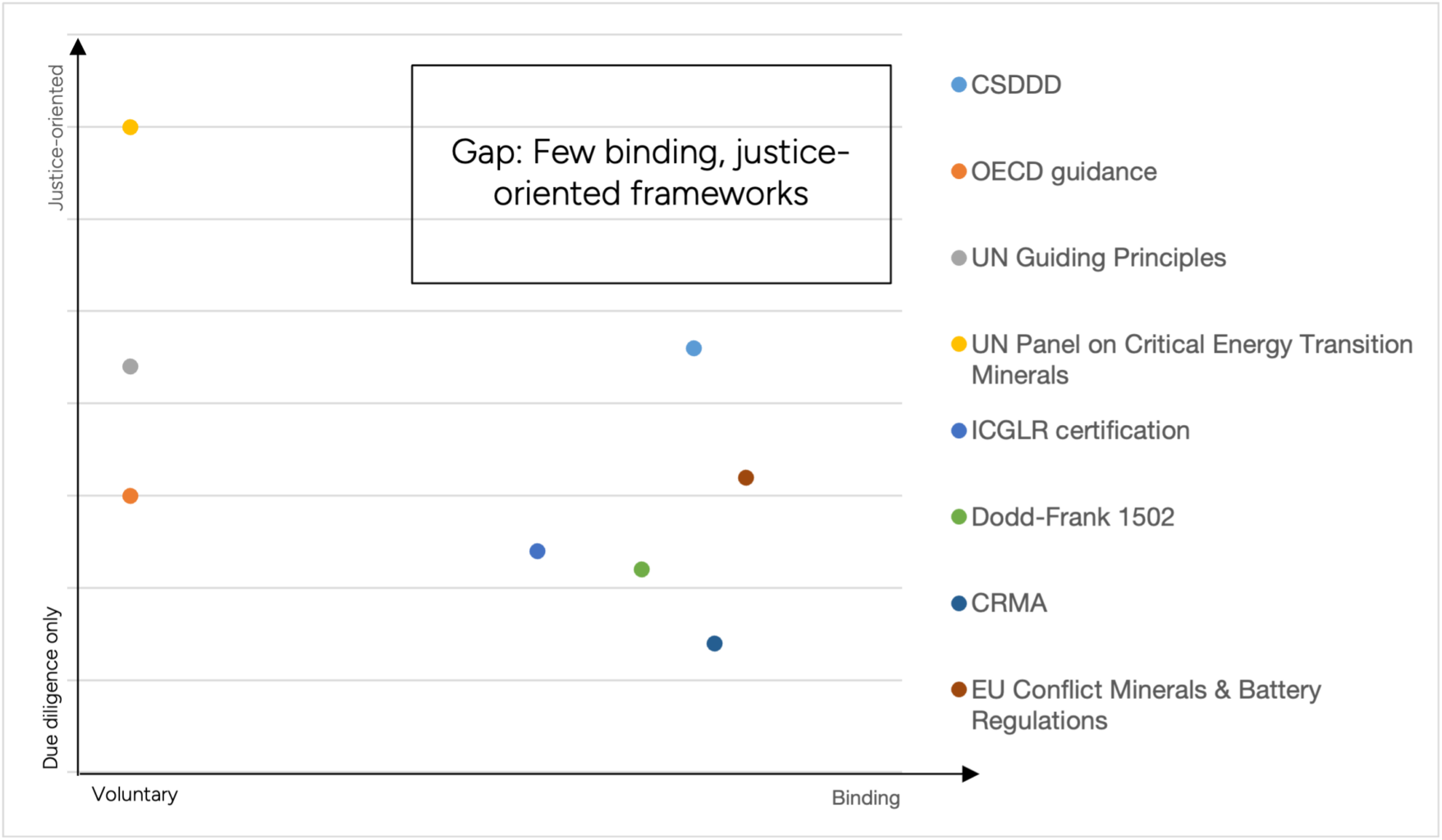
Such an assessment could plot instruments along two axes: legal bindingness (from voluntary guidance to directly applicable regulation) and justice orientation (the extent to which operative provisions – not stated purpose – engage distributive, procedural and restorative justice). Coding should draw on each instrument’s binding text rather than its preamble, remain qualitative and transparent rather than a numerical score, and stay open to challenge and revision by legal experts. Panzi Foundation presents the figure below solely as an illustration of this possible methodology for consideration and adaptation within the July discussions; it is not intended as a definitive scoring or ranking of individual instruments. Rather, it draws on existing comparative legal approaches and aims to demonstrate how future assessments could more systematically examine the relationship between legal design, enforceability, and justice outcomes.
Closing the gap between principle and practice
The international community does not lack principles or frameworks relevant to the governance of natural resources, nor does it lack recognition of the importance of justice. Rather, it lacks a coherent governance architecture capable of integrating these principles into a system that confronts the historical, political, and economic drivers of inequality embedded in mineral extraction. Too often, existing frameworks address the consequences of governance failures as isolated risks or externalities, rather than addressing the structural conditions that produce and perpetuate them.
Closing this normative gap therefore requires moving beyond a framework primarily focused on identifying and mitigating risks toward one that embeds justice as a foundational objective of mineral governance. This means not only preventing harm but ensuring that governance systems are designed to generate equitable outcomes, strengthen accountability, and create lasting value for the people and environments on which mineral development depends.
For Panzi Foundation, that is where the assessment of the normative gap should begin.
“Our greatest legacy will not be the minerals we extract, but the society we build with them.” Dr Denis Mukwege
For any media inquiries, please reach out to media@panzi.org.
—
About Panzi Foundation
Panzi Hospital and Foundation provides survivors of sexual violence with access to compassionate, holistic care in the Democratic Republic of Congo. At Panzi, survivors receive comprehensive health services, psychosocial support, job-skills training and socio-economic reintegration opportunities, as well as access to legal services. Since 1999, Panzi has served over 87,000 survivors across the country, empowering them to not only survive, but to thrive as they rebuild their lives.
- UN General Assembly Resolution 1803 (XVII), Permanent Sovereignty over Natural Resources, 14 December 1962, para. 1. ↩︎
- UN General Assembly Resolution 41/128, Declaration on the Right to Development, 4 December 1986, arts. 1, 2 and 8. ↩︎
- Cobalt Institute, Cobalt Factsheet (July 2025), citing Cobalt Institute Market Report 2024. ↩︎
- UN Trade and Development (UNCTAD), Global Trade Update: The Shifting Dynamics of Critical Minerals Trade (June 2026). ↩︎
- While fairness is increasingly referenced in discussions on critical minerals and the energy transition, its meaning in the context of mineral governance remains insufficiently developed. See Heffron (2022), who highlights the need for a more robust understanding of fairness in the context of the energy transition. ↩︎